Air quality plays a critical role in maintaining clean environments, especially in industries such as pharmaceuticals, healthcare, electronics, and research laboratories. One of the most effective ways to monitor air cleanliness is by understanding how to count air particles accurately. In this blog, I will explain the concept in simple terms, the methods used, the equipment required, and why air particle counting is essential. This guide is written to help beginners and professionals who want a clear and practical understanding of the process.
What Are Air Particles?
Air particles are tiny solid or liquid substances suspended in the air. These particles may include dust, smoke, pollen, microorganisms, or chemical aerosols. In controlled environments like cleanrooms, even a small increase in airborne particles can affect product quality, safety, and compliance.
Understanding how to count air particles helps organizations maintain clean standards and prevent contamination in sensitive processes.
Why Is It Important to Count Air Particles?
Counting air particles is not just a technical task; it is a quality assurance measure. Industries rely on particle counting to meet regulatory standards and ensure safe working conditions.
Key reasons to measure air particles include:
- Maintaining cleanroom classification standards
- Preventing contamination in pharmaceutical production
- Protecting sensitive electronic components
- Ensuring patient safety in hospitals and laboratories
- Monitoring indoor air quality
When you know how to count air particles, you gain better control over your environment.
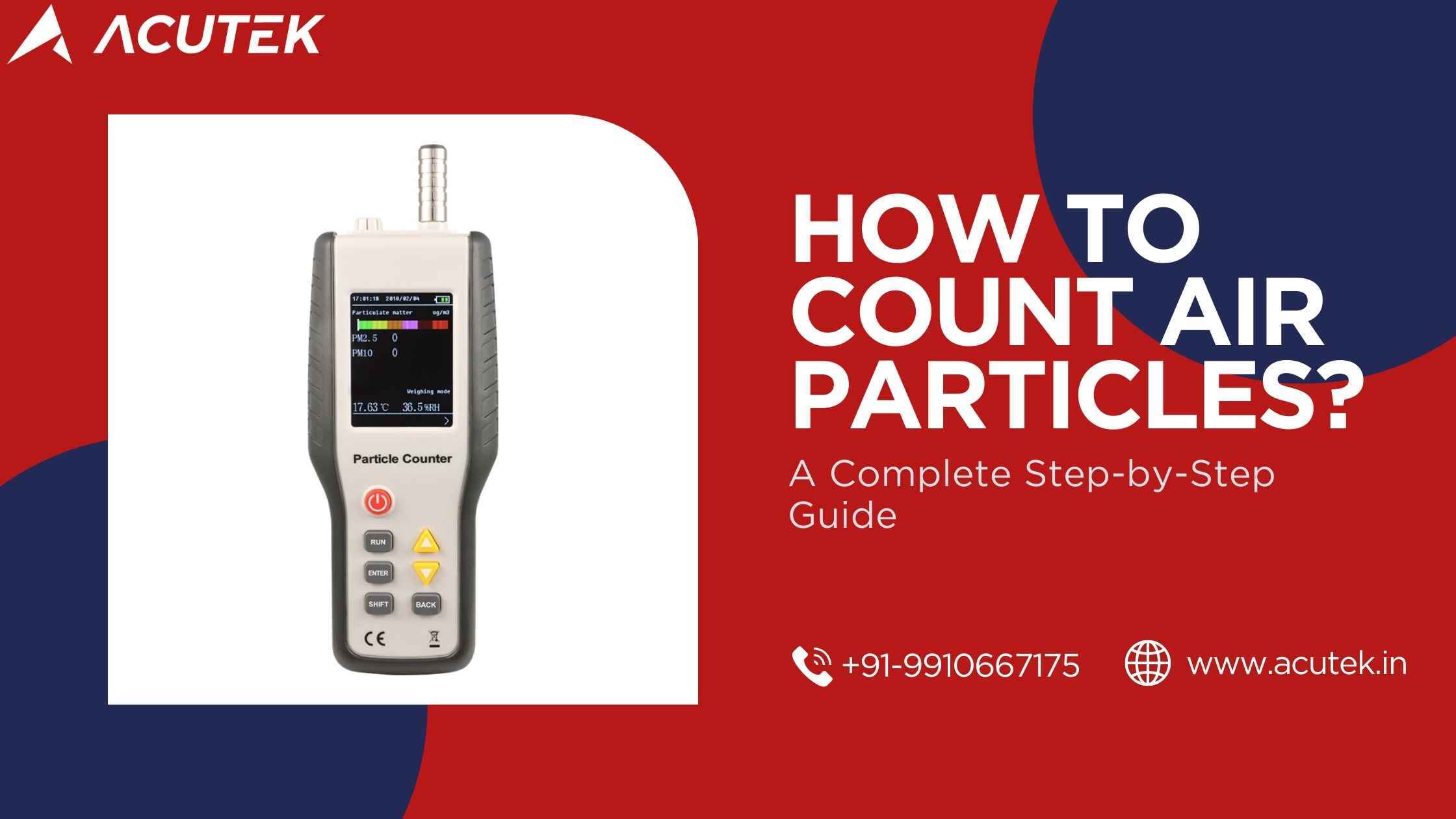
How to Count Air Particles Using a Particle Counter
The most reliable way to measure airborne particles is by using an air particle counter. This instrument detects and counts particles of different sizes present in a specific volume of air.
Step-by-step process:
- Select the right particle counter based on the required particle size range
- Place the device in the area where air quality needs monitoring
- Set the sampling volume and time according to standards
- Start air sampling, allowing air to pass through the sensor
- Analyze the results, which display particle counts by size
This method clearly explains how to count air particles with accuracy and consistency.
Types of Air Particle Counters
Different environments require different types of particle counters.
Common types include:
- Portable particle counters – ideal for routine inspections
- Remote particle counters – used in fixed cleanroom installations
Each type helps users understand how to count air particles based on specific applications.
Standards Followed for Air Particle Counting
Air particle measurement follows international standards to ensure consistency and reliability.
Widely used standards:
- ISO 14644 for cleanroom classification
- GMP guidelines for pharmaceutical environments
- USP standards for sterile manufacturing
Following these standards ensures that air particle data is accurate and accepted globally.
Applications of Air Particle Counting
Air particle counting is used across multiple industries to maintain quality and compliance.
Major applications include:
- Pharmaceutical and biotech manufacturing
- Hospital operating rooms and ICUs
- Semiconductor and electronics production
- Research and testing laboratories
- HVAC system validation
Knowing how to count air particles helps maintain clean and controlled environments in all these areas.
Common Mistakes to Avoid While Counting Air Particles
Even with advanced equipment, mistakes can affect measurement accuracy.
Avoid these common errors:
- Incorrect placement of the particle counter
- Not calibrating the instrument regularly
- Ignoring airflow patterns in the room
- Using the wrong sampling time
Proper handling ensures reliable results when learning how to count air particles effectively.
Conclusion
Understanding how to count air particles is essential for maintaining clean, safe, and compliant environments. By using the right particle counter, following standard procedures, and avoiding common mistakes, organizations can accurately monitor air quality. Whether in cleanrooms, laboratories, or healthcare facilities, air particle counting ensures better control, improved safety, and higher product quality.
Contact Us
Website: www.acutek.in
Phone No.: +91-9910667175
FAQs
Q1. What is the best method to count air particles?
Ans. The most accurate method is using a calibrated air particle counter that measures particles based on size and concentration.
Q2. How often should air particles be counted?
Ans. The frequency depends on the application, but cleanrooms usually require regular monitoring, daily or weekly.
Q3. Can air particles be seen with the naked eye?
Ans. Most air particles are microscopic and cannot be seen without specialized instruments.
Q4. Which industries require air particle counting?
Ans. Pharmaceuticals, healthcare, electronics, food processing, and research labs all rely on air particle monitoring.
Q5. Is air particle counting mandatory?
Ans. In regulated industries, air particle counting is mandatory to meet quality and safety standards.