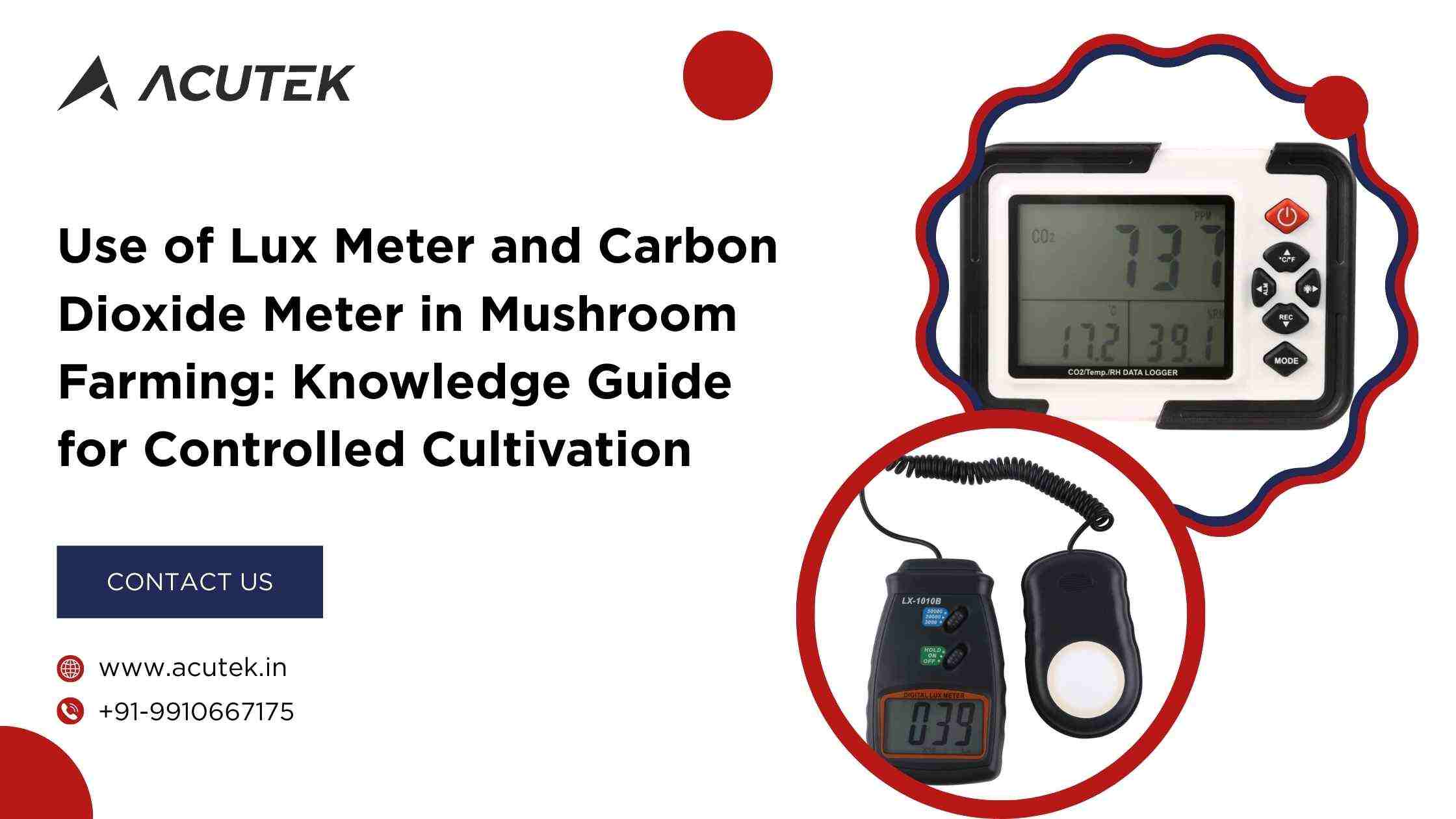
Mushroom cultivation requires precise control of environmental conditions to achieve consistent yield, quality, and predictable growth cycles. Unlike traditional crops, mushrooms are highly sensitive to light intensity and carbon dioxide concentration. Understanding the use of lux meter and carbon dioxide meter in mushroom farming helps growers monitor and maintain optimal conditions throughout different cultivation stages.
This Knowledge Center article explains how these instruments support controlled mushroom farming, their importance, applications, and benefits in professional cultivation environments.
Environmental Control in Mushroom Farming
Mushrooms grow best in carefully controlled environments where parameters such as light, temperature, humidity, and air composition are regulated. Among these factors, light intensity and carbon dioxide levels directly influence mushroom shape, size, and productivity. The use of lux meter and carbon dioxide meter in mushroom farming allows growers to measure these parameters accurately and make informed adjustments.
Reliable handheld instruments, such as digital lux meters designed for a wide measurement range and compact carbon dioxide monitors used in grow rooms, make routine environmental checks practical even in large cultivation facilities. Effective monitoring ensures that environmental conditions remain within recommended ranges for different mushroom varieties.
Role of Lux Meter in Mushroom Cultivation
A lux meter is used to measure light intensity in terms of lux. While mushrooms do not rely on light for photosynthesis, controlled light exposure plays an important role in orientation, pinhead formation, and fruiting body development. The use of lux meter and carbon dioxide meter in mushroom farming ensures that light levels are neither excessive nor insufficient.
In controlled farming environments, instruments such as the Acutek Lux Meter 0–50,000 lux LX-1010B are commonly used to verify uniform lighting across racks and growing rooms. This helps growers maintain consistent conditions during critical growth phases.
Importance of lux measurement includes:
- Supports uniform mushroom growth
- Prevents abnormal cap and stem development
- Helps regulate fruiting cycles
- Ensures consistency across growing rooms
Accurate lux measurement allows growers to standardize lighting conditions across cultivation areas and reduce variability between batches.
Importance of Carbon Dioxide Monitoring in Mushroom Farming
Carbon dioxide concentration has a direct impact on mushroom morphology and yield. Elevated CO₂ levels can result in elongated stems and smaller caps, while insufficient control may disrupt growth rates. The use of lux meter and carbon dioxide meter in mushroom farming helps maintain balanced air composition throughout the cultivation cycle.
Portable monitoring devices, such as the Carbon Dioxide Monitor HT-200, are often used in mushroom grow houses to track CO₂ buildup and guide ventilation adjustments in real time.
Why CO₂ monitoring is essential:
- Controls stem and cap development
- Supports healthy respiration of mushrooms
- Prevents growth abnormalities
- Improves overall crop quality
Continuous monitoring enables timely corrective action, ensuring stable environmental conditions.
Benefits of Using Lux Meter and Carbon Dioxide Meter in Mushroom Farming
Implementing professional measurement tools provides measurable operational advantages. The use of lux meter and carbon dioxide meter in mushroom farming enhances both production efficiency and crop consistency.
Key benefits include:
- Improved yield quality and uniformity
- Better environmental consistency
- Reduced crop loss due to imbalance
- Optimized growth cycles
- Data-driven cultivation decisions
Accurate monitoring supports predictable outcomes and scalable mushroom farming operations.
Applications in Different Mushroom Growth Stages
Mushroom cultivation involves multiple stages, each with specific environmental requirements. The use of lux meter and carbon dioxide meter in mushroom farming supports precise control during every phase.
Key cultivation stages include:
- Spawn run stage
- Pinning stage
- Fruiting stage
- Harvest preparation stage
By adjusting light intensity and CO₂ levels at each stage, growers can achieve consistent development and higher-quality produce.
Role in Commercial and Controlled Environment Farming
In commercial mushroom farming, maintaining uniform conditions across multiple growing rooms can be challenging. The use of lux meter and carbon dioxide meter in mushroom farming supports standardized environmental control in climate-controlled facilities.
Advantages for commercial farming include:
- Supports large-scale production consistency
- Reduces manual guesswork
- Improves repeatability across batches
- Assists in quality assurance documentation
Such instruments are essential for professional operations focused on reliability, traceability, and efficiency.
Contribution to Quality Control and Yield Optimization
Environmental measurement instruments play a critical role in quality control. The use of lux meter and carbon dioxide meter in mushroom farming helps growers detect deviations early and take corrective action before yield or quality is affected.
Quality control advantages include:
- Early detection of environmental imbalance
- Better crop appearance and texture
- Consistent harvest size and weight
- Improved market acceptance
Accurate monitoring leads to higher productivity, reduced operational risk, and better overall farm performance.
Conclusion
Controlled environmental conditions form the foundation of successful mushroom cultivation. The use of lux meter and carbon dioxide meter in mushroom farming enables precise monitoring of light intensity and air composition—two factors that directly influence growth, yield, and quality. By integrating reliable instruments into routine cultivation practices, growers can achieve consistent production, reduce crop variability, and improve overall farming efficiency. As mushroom farming continues to evolve toward controlled and commercial systems, dependable measurement tools remain essential for sustainable, high-quality cultivation.
Contact Us
Website: www.acutek.in
Phone No.: +91-9910667175
FAQs
Q1. Why is light measurement important in mushroom farming?
Ans. Light influences mushroom orientation, pinning, and fruiting, making controlled lux levels essential.
Q2. How does carbon dioxide affect mushroom growth?
Ans. Excess CO₂ can cause elongated stems and smaller caps, while balanced levels support healthy growth.
Q3. Can lux meters be used for all mushroom varieties?
Ans. Yes, although optimal light levels vary depending on species and growth stage.
Q4. Are carbon dioxide meters required for commercial mushroom farming?
Ans. They are highly recommended to maintain consistent quality and prevent growth abnormalities.
Q5. Do these instruments help increase yield?
Ans. Yes, accurate monitoring enables better environmental control, resulting in improved quality and yield consistency.